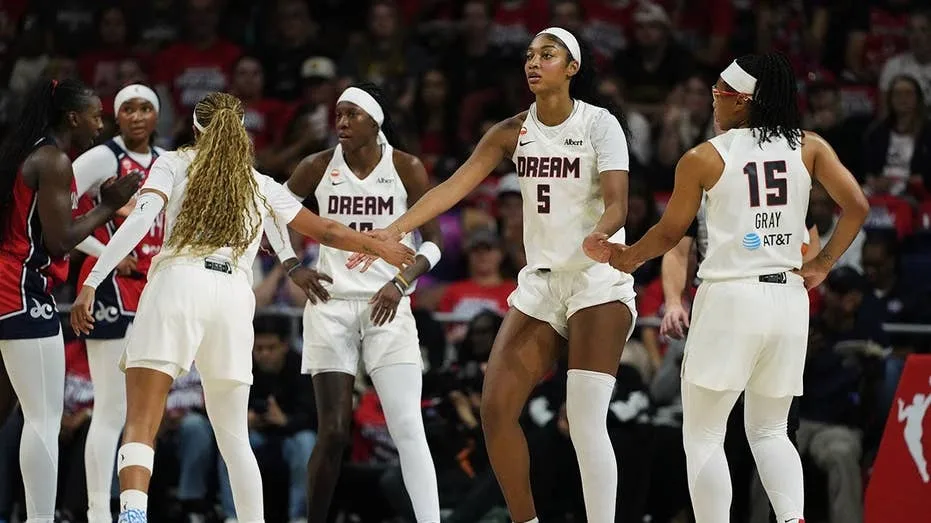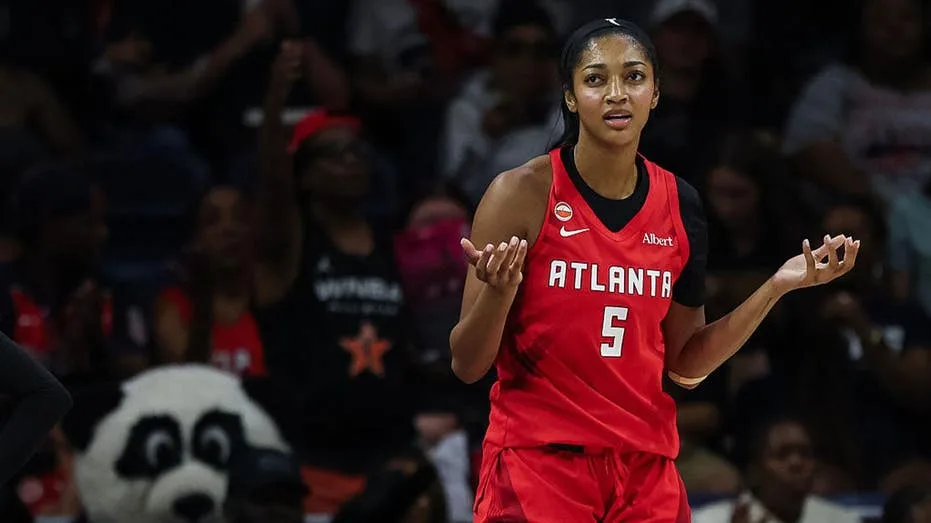
Atlanta Dream forward Angel Reese was certainly a contender for the WNBA’s Defensive Player of the Year accolade. Her formidable rebounding, relentless effort, and knack for forcing turnovers presented compelling reasons for voters to include her in the discussion.
However, simply being in the discussion appeared to be just the beginning of her campaign.
Examining the Vote Distribution
Reese ultimately received 46 of the 74 votes cast for the award, which was announced on Thursday. Gabby Williams, a forward for the Golden State Valkyries, finished in second place with 20 votes. Las Vegas Aces center A’ja Wilson, widely considered by many as the premier defender in the WNBA, garnered only four votes.
This outcome, with Reese receiving more than eleven times the votes of Wilson and over twice as many as Williams, aligns with a long-held observation regarding the coverage surrounding Reese. There is a perception that many within the media are so eager for her to be an elite player that they tend to overstate her actual on-court contributions.
An award determined by sportswriters and broadcasters offers a convenient justification when questions arise about this assessment. The narrative becomes: "She’s undeniably elite. Just look at the award we bestowed upon her."
Team Performance and Defensive Ratings
The Atlanta Dream concluded their season with a 30-14 record. They ranked third in defensive rating, allowing 103.5 points per 100 possessions, which indicates a strong defensive performance. Yet, a closer look at the team’s trajectory after Reese’s addition last offseason reveals a notable consistency.
Last year, the Dream finished with an identical 30-14 record. Despite bringing in the presumed Defensive Player of the Year, the team’s defense did not show a clear improvement. In 2025, the Dream held the second-best defensive rating, surrendering only 98.9 points per 100 possessions. This suggests Atlanta already possessed one of the league’s top defenses prior to Reese’s arrival, and in fact, the team’s defensive efficiency slightly declined this year.
This observation does not imply Reese negatively impacted Atlanta’s defense. Roster dynamics shift, opponents evolve, and comparing defensive ratings across seasons requires considering numerous variables. Nevertheless, anyone portraying her arrival as a dramatic defensive transformation must reconcile it with the team's stagnant win total and marginally worse defensive rating.
Reese did contribute significantly to Atlanta allowing a league-low 9.5 second-chance points per game. She also boasted an impressive average of 1.8 steals and led the league in defensive win shares. However, it is important to remember she joined a team that already achieved 30 wins and exhibited elite defensive capabilities.
Comparing Defensive Prowess: Reese vs. Wilson
A’ja Wilson provides defensive versatility that Reese does not offer at the same level. Wilson excels at protecting the basket, can effectively switch onto smaller guards, and is capable of defending possessions that lead her far from the paint.
In a crucial August game against Indiana, Wilson famously guarded Caitlin Clark in overtime, forcing the turnover that led to Chelsea Gray’s game-winning three-pointer. Following that contest, Aces coach Becky Hammon remarked, "I’ll take that matchup … any day."
It is unlikely the Atlanta Dream would deploy Reese to defend a perimeter player like Clark in a game-deciding scenario. If such a matchup were to occur, it would suggest significant tactical missteps by the Dream's coaching staff and players.
While Reese’s active play near the basket is valuable, Wilson’s capacity to handle diverse defensive assignments is a primary reason she is considered the league’s top defender.
Wilson has led the league in blocks for five consecutive seasons, averaging 1.9 blocks per game, compared to Reese’s 0.7. Notably, Wilson also averaged more defensive rebounds per game (7.5) than Reese (7.3), in addition to her 1.4 steals per game.
The defensive rebounding comparison often gets overshadowed by the celebration of Reese’s overall rebounding records. Of her 521 total rebounds this season, 206 were offensive. While creating extra possessions is valuable, these do not count as defensive stops and should not be a factor in Defensive Player of the Year considerations. Furthermore, some of Reese's rebounds are "mebounds"—recovering her own missed shots.
Scrutiny of Advanced Metrics and Voter Rationales
Wilson also has advanced statistics bolstering her case. Jack Maloney of CBS Sports, a voter who ultimately chose Reese, acknowledged that Wilson led the league in defensive VPM (Value Per Possession), an advanced metric that estimates a player’s impact on preventing points.
Gabby Williams also presented a strong argument. She consistently took on the toughest scoring assignments for Golden State’s top-ranked defense. The WNBA’s own awards preview highlighted Synergy tracking data, which placed her first in points allowed per possession across various tracked play types.
Consider how Edwin Garcia of Swish Appeal, an official awards voter, characterized Reese’s defense. "At the rim, she was a black hole, devouring everything that even attempts to enter the paint," Garcia wrote, also calling her a "shoo-in" for the award.
However, a player averaging fewer than one block per game being described as "devouring everything near the basket" raises questions. While rim protection involves more than just blocking shots, Garcia’s description portrays Reese as an overwhelming shot-blocking force, which her statistics do not support.
Garcia also relied on Atlanta’s defensive on/off numbers, citing a 15.5-point difference when Reese was off the floor. Jack Maloney of CBS Sports also used on/off figures, noting a 13-point gap in his explanation for selecting Reese. Curiously, Atlanta’s official award announcement stated a 7.9-point difference.
This wide variance in a statistic suggests an excessive amount of confidence placed in a number that fluctuates significantly depending on its source and the timing of its calculation. Furthermore, on/off metrics measure the collective performance of five players, not solely an individual’s defensive contribution.
The version of this metric from Hoops Junkie presents another interesting point. Its defensive on/off comparison placed Aces guard Jackie Young at 15.1 points and A’ja Wilson at 7.0, suggesting Young had a much greater apparent impact on the Aces’ defense.
Are observers truly expected to believe Young is more vital to Las Vegas’s defense than Wilson? Watching the Aces play quickly disproves such a notion. Young is a capable defender, but Wilson is the player consistently protecting the basket, securing rebounds, and managing defensive assignments that most centers would struggle with.
A metric that positions Young so far ahead of Wilson warrants careful examination before becoming the definitive argument for a defensive award.
Noa Dalzell, an SB Nation voter, cited opponents’ worse shooting percentages with Reese on the floor, writing, "if Angel Reese is guarding you, your team starts missing shots."
However, being on the floor and directly guarding the shooter are distinct actions. Reese receives credit in such comparisons even when a teammate forces a difficult shot or an opponent simply misses an open one. Attributing a team’s overall shooting numbers to Reese personally shutting down opponents overstates what these figures truly establish.
Dalzell, like Maloney, acknowledged that Wilson led the league in DVPM and also pointed out that Reese trailed both Gabby Williams and Aliyah Boston in that particular metric.
It is noteworthy that two voters openly recognized an important individual defensive metric that favored Wilson, yet they opted to prioritize team on/off figures. Unsurprisingly, they leaned more heavily on statistics that seemed to support Reese’s case, even if those statistics might not be the most accurate indicators of individual defensive performance.
Reese’s on/off advantage is a valid point when advocating for her Defensive Player of the Year candidacy. However, it does not fully explain why Wilson barely registered in the voting, or why Williams received less than half as many votes as Reese.
This discrepancy has been a recurring issue in the media’s portrayal of Reese. She is undoubtedly a very good player, but she has limitations that many covering her appear determined to overlook. Now, a strong defensive season has culminated in a landslide award victory, allowing the same media that presented her with the trophy to cite it as validation of their initial assessment. It creates a self-reinforcing cycle of affirmation.
Reese unquestionably deserved to be considered for the award. Yet, the final tally of 46 votes for her compared to 20 for Williams and just four for Wilson suggests a media contingent that was exceptionally eager to create something to celebrate.