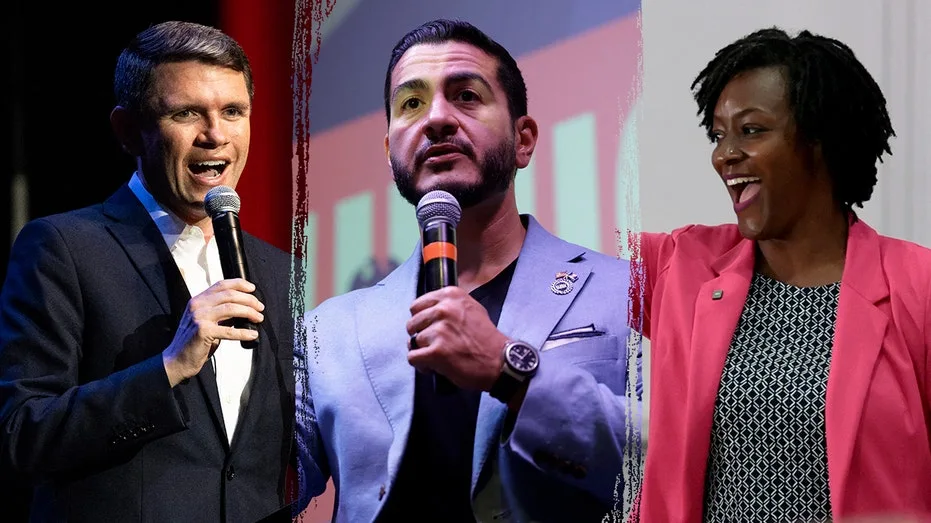
A growing number of progressive candidates vying for Senate seats are adopting a strategy previously associated with their Republican counterparts: integrating faith into their political messaging to forge deeper connections with the electorate.
Three prominent Democratic hopefuls — Florida state Representative Angie Nixon, Abdul El-Sayed, and Texas state Representative James Talarico — have notably challenged established Democratic norms during their campaigns this midterm cycle. Each has also woven their personal religious beliefs and faith into their public communication, reminiscent of the "Moral Majority" coalition that emerged in the Republican Party during the late 1970s, a period when Ronald Reagan's campaign aimed to link policy positions with Christian principles.
Framing Policy Through Religious Conviction
Angie Nixon, who secured an unexpected victory against Alexander Vindman—a key figure during former President Donald Trump’s initial impeachment proceedings and a candidate backed by Washington's Democratic establishment—has become a frequent target for the Republican Party due to her ties to the Democratic Socialists of America (DSA).
During a sermon delivered recently at the Saint Paul AME Church in Jacksonville, Florida, Nixon, who is slated to face Florida Senator Ashley Moody in November, asserted that her "radical" political stances aligned with the teachings of Jesus Christ.
"They are trying, y'all. They are trying … to label me as this extremist, this radical. But, you know, Jesus was a radical," Nixon stated. "And Jesus fought for — I mean, he pushed for the same things that I'm fighting for today, right? Right now, we're literally in a civil rights moment. Whether or not people wanna believe it or not, but we are."
Her decision to join the DSA in June immediately drew criticism from the National Republican Senatorial Committee (NRSC), the Senate Republican campaign organization, which sought to associate her with socialism. Nixon, however, has denied identifying as a Democratic socialist.
Invoking Christ's 'Radical' Stance
Nixon is not the only one of the three candidates to draw such comparisons. Abdul El-Sayed, who is Muslim and running in Michigan's competitive Senate race against former Representative Mike Rogers, similarly invoked Christ during an appearance on the Progressive Christians Podcast in May.
When questioned about his policy positions and why they might be labeled as radical, El-Sayed responded:
"Well, you know, Jesus, peace and blessings be upon him, was considered radical in his time, too. And there is a radical nature to being willing to stand forthright in a time of corruption, and I think it's important for all of us to realize that popularity and zeitgeist don't make truth. And we live in a time where people are trying to normalize corruption."
A Theological Approach to Policy
Among the three, James Talarico, who is campaigning in a closely watched Texas race against Attorney General Ken Paxton, has most openly integrated his faith into his public persona. Talarico has been pursuing seminary studies to become a Presbyterian minister and has consistently blended Christian tenets with his policy platform since launching his candidacy last year.
Like his fellow candidates, Talarico's use of faith has become a point of contention for Republicans, particularly concerning his defense of transgender children. In 2021, while opposing a newly enacted anti-trans bill by the Texas Republican Party, Talarico contended that Texas Republicans were attempting to legitimize the measure "in the name of God's law."
He further elaborated on his interpretation of divine nature, referencing biblical texts:
"The first two lines of the Bible, the first two lines in Genesis, use two different Hebrew words to describe God. One is the masculine Hebrew noun for divinity. The second is the feminine Hebrew noun for spirit. God is both masculine and feminine, and everything in between." He concluded, "God is non-binary."