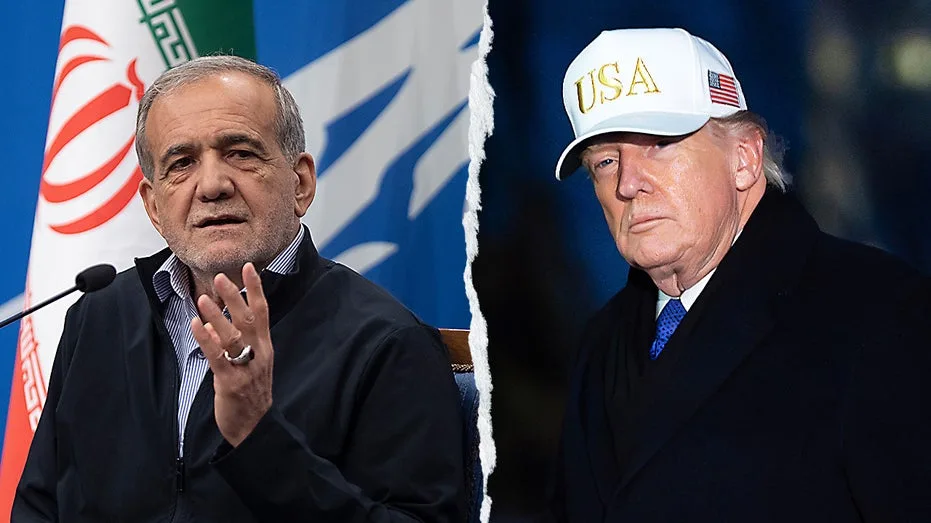
At the United Nations General Assembly in New York, President Trump and Iranian President Pezeshkian delivered addresses from the same platform within a 24-hour period, exchanging strong criticisms as the strained relationship between Washington and Tehran continues to intensify.
President Pezeshkian's speech included accusations against the United States and Israel, alleging they had attacked Iran. He presented his nation as a target of aggression. He asserted that Iran had merely acted in self-defense, stating, "We have only defended ourselves. We are not terrorists." Pezeshkian further contended that the Iranian populace had "been the targets of cowardly attacks and aggressions imposed upon our country," explicitly blaming "America and Israel" for these actions.
An expert commented on Pezeshkian's address, suggesting that the "crassness" of the remarks would likely have elicited "a smirk or a smile or a chuckle" from President Trump. This observation highlighted a perceived disparity between Pezeshkian's statements and Iran's historical actions.
President Pezeshkian's presentation followed President Trump's appearance on the same UN platform, where Trump defended the United States' confrontational stance with Iran. Trump issued a strong warning, indicating that Tehran faced a critical decision: either negotiate an agreement or confront severe consequences. On Tuesday, Trump posed a rhetorical question: "Or do I annihilate the Islamic Republic, and do it quickly, never giving them a chance to kill and destroy people and countries again?"
Clashing Narratives on the World Stage
Despite the sharp tone adopted by both heads of state, the expert noted that their overarching diplomatic postures largely aligned with established expectations. He elaborated, "To a certain degree, both President Trump and President Pezeshkian’s speeches before the U.N. General Assembly’s 81st session were predictable." This predictability, he explained, stemmed from the current "fairly predictable pattern" governing the relationship and foreign policy approaches of both nations.
Behind-the-Scenes Engagement Amid Public Confrontation
Notwithstanding the public exchange of threats and accusations, it appears that both nations are simultaneously exploring diplomatic avenues through discreet channels.
On Tuesday, President Trump disclosed that U.S. special envoy Steve Witkoff and Jared Kushner engaged in discussions with Iranian officials for approximately three hours during the General Assembly. Trump described these interactions as productive.
Witkoff subsequently clarified that these talks were facilitated by mediators who moved between the American and Iranian delegations.
Reports indicated that Iranian Foreign Minister Abbas Araghchi was also involved, representing Tehran in these discussions.
The expert observed that both parties are endeavoring "to make time a weapon on their side" and strategically "to put the burden of choosing between escalation and engagement on the other."
Predictable Posturing and Unchanged Red Lines
The expert further analyzed President Pezeshkian’s overarching communication, interpreting it as an effort to portray Iran as a victim within an anti-American, anti-Israeli, and anti-imperialist perspective. He stated, "It seemed to be more of a global South, anti-American, anti-Israeli, kind of anti-colonial, anti-imperialist message that he was looking to kind of paint the Islamic Republic as the victim." He concluded that, in truth, the "long-serving victim in this entire crisis is the Iranian people because of the policies of the Islamic Republic."
The juxtaposition of confrontational public statements at the UN podium with discreet diplomatic efforts underscored the persistent unresolved tensions between Washington and Tehran, as officials assess whether negotiations might offer a path to de-escalation.
According to the expert, "Despite the tough talk at the podium, both sides still feel like they need to signal an interest in talks, even though they’re both trying to use talks to shape an outcome that is more conducive to their interests."
President Pezeshkian also conveyed to the General Assembly that Tehran would resist military pressure, simultaneously indicating that Iran remained amenable to diplomatic solutions.
However, the expert cautioned that while "the Iranians are trying to signal an interest in talks," they "may run into a brick wall quite soon if they foot-drag or delay or don’t meaningfully provide any kind of substantive change in their policy." He specifically referenced Iran's stances on the Persian Gulf, the Strait of Hormuz, and its nuclear program. He concluded that "Ultimately, if the positions remain the same, the fact that they’re oscillating between shooting and talking doesn’t mean much because the red lines haven’t actually moved." He also noted that "the Trump administration is looking for a political win here."