The initial release of the College Football Playoff committee's rankings last week was met with significant skepticism, frustration, and even anger from many observers and commentators who questioned the methodology behind the selections.
Committee chairman Hunter Yurachek's subsequent interview, attempting to clarify the rankings, only seemed to compound the issues, revealing what many perceived as logical gaps and unclear reasoning. Despite widespread public discontent, there was a faint hope that the second week's poll might address some of these concerns or at least acknowledge a potential overemphasis on "strength of schedule" favoring a particular conference.
However, Tuesday night's second ranking announcement appears to have solidified, if not deepened, the existing frustrations. This week's poll amplified the perceived favoritism toward one conference, while Yurachek's defense of certain inexplicable changes reinforced the notion that the committee operates without consistent, established criteria.
Inconsistent Drops: Miami and Indiana
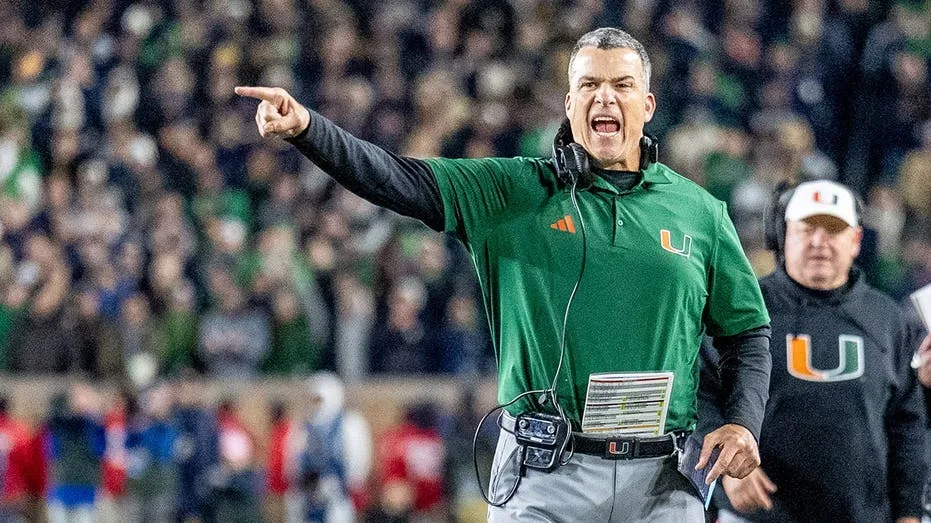
A prime example of these inconsistencies involves the Miami Hurricanes, previously the nation's top-ranked team.
Miami, undefeated and widely considered the No. 1 team, faced a challenging road game against a highly-rated Notre Dame squad, ranked No. 4 in the AP Poll and No. 11 by the CFB Playoff committee. The Hurricanes competed without their standout player, Malachi Toney.
In a pivotal moment, with 3:36 remaining and facing 4th-and-6 at Notre Dame's 18-yard line, Miami appeared to complete a pass for a game-tying touchdown. Replays seemed to indicate the receiver secured the ball with one foot in bounds before stepping out and losing control. Nevertheless, officials ruled the pass incomplete, a decision upheld upon review. Miami ultimately lost a close contest, 31-24, a score that underscored the game's tight margins.
Given this scenario – a narrow road loss to a highly-ranked opponent while missing a key player – one might expect a modest drop in the rankings. This standard has often been observed for teams from the Southeastern Conference (SEC), where a close road defeat to a top-tier opponent might result in a one-spot drop, if any.
Instead, Miami plummeted six places to No. 7. In contrast, when the Georgia Bulldogs suffered a home loss to a moderately performing Auburn Tigers team, AP Poll voters adjusted their ranking by only four spots. This disparity often fuels resentment among fans of other conferences, who perceive a lack of consistent evaluation criteria and a consistent advantage for one specific conference.
Another striking example of an unusual drop occurred with the Indiana Hoosiers, who fell to No. 9. Indiana, previously ranked No. 4, was on a bye week and did not play any games before their significant upcoming matchup against USC on Saturday. Despite their inactivity, they descended five positions.
This unexplained shift prompted a question to Chairman Yurachek, who attempted to provide a rationale.
Questionable Justifications and Perceived Bias
Yurachek attributed Indiana's drop to unfortunate timing, stating,
Indiana was probably a victim of having a bye week at the wrong time with seven games between Top 25 teams. The committee is really impressed with what UCLA, Texas, and Notre Dame did as well as Alabama and LSU.
He further elaborated,
Every team that Indiana had played to date in the Big Ten all lost and that effected their strength of schedule rank and the committee's review of Indiana. The quarterback play in general and the offensive play in general is kind of a discussion point of Indiana...They've won games because of their defense and not their offense.
These explanations have been met with skepticism. The notion that a team's method of winning – specifically, relying on defense – should negatively impact its ranking is inconsistent with historical precedents, particularly for dominant defensive teams from conferences like the SEC. For instance, teams under Nick Saban at Alabama or early Kirby Smart at Georgia often received acclaim for their defensive prowess, framed as a testament to toughness and a 'defense wins championships' philosophy. Applying a different standard to Indiana's defensive success appears contradictory.
Moreover, the argument that Indiana's opponents losing justifies their drop raises questions, especially when Alabama is not penalized for the struggles of Mississippi State, one of their past opponents. The article also points out that while Indiana's non-conference schedule is often criticized, ESPN's FPI metrics suggest their best non-conference opponent, North Texas, would be an 8.5-point favorite over Georgia Tech, which many consider Georgia's 'toughest' non-conference opponent and holds a 2-7 record. This highlights how perception and established brand names can often overshadow objective performance.
Ironically, the committee cited being 'impressed' by UCLA's performance, which included a victory over Minnesota. Indiana had also defeated the same Minnesota team the week prior to their bye. While UCLA's winning margin was higher, the consistent importance of scoring margin to the committee's evaluations has often been unclear.
Further Ranking Anomalies
Beyond Miami and Indiana, other ranking decisions also raise eyebrows. The Kentucky Wildcats, for instance, suffered two significant blowout losses, each by 28 points, yet only dropped five spots. This again brings into question the committee's application of scoring margin as a factor.
Further down the list, USC, with a 7-2 record, climbed two positions to No. 18. However, they remain behind Iowa, also 7-2, and several teams with three losses, including South Carolina and Missouri. Missouri, despite a 7-3 record, has what many consider an underwhelming resume.
Missouri's non-conference schedule included Arkansas Pine Bluff, Kansas, and Troy. Their conference record features a loss to Mississippi State, wins against a struggling Florida and a mediocre Texas A&M, a blowout loss to Ole Miss, a win over a poor Arkansas team, and a loss to Texas. Despite this, their ranking is speculated to be partly due to an upcoming game against Kentucky, providing another 'ranked game' opportunity for the SEC.
Arizona, with a 6-2 record, dropped a spot despite their two close losses occurring on the road against BYU and Texas Tech. Notably, they achieved a one-possession home victory over 4-5 TCU. In contrast, South Carolina, after a one-possession home win against 4-5 Texas A&M, rose four spots.
LSU continues to be ranked despite a lack of impressive victories. They have lost every game against a perceived 'quality' opponent, including Ole Miss, Kentucky, and Alabama. Their most significant win cited was a 63-14 rout of McNeese State.
The head-to-head matchup between Tennessee and Alabama also presents a puzzle, with Tennessee holding a victory over Alabama but ranked five spots below them. Chairman Yurachek dismissed these concerns by referring to 'made-up pods' the committee uses for comparisons, suggesting that head-to-head results are selectively considered.
Conclusion: Calls for Transparency and Consistency
The events of the past two weeks strongly suggest that the College Football Playoff committee operates without a truly consistent and meaningful set of standards. Decisions regarding strength of schedule appear heavily influenced by perception and established team brands. The weight given to head-to-head results or injuries to critical players also seems inconsistent.
It appears the committee may be selecting teams based on desired outcomes and subsequently developing post-hoc justifications. This approach explains the week-to-week inconsistencies, such as Indiana's five-spot drop during a bye week, and why Chairman Yurachek's explanations are often easily challenged.
Addressing these issues would require a more comprehensive solution, but a foundational step would be the establishment and rigorous enforcement of clear, consistent evaluation criteria. Greater transparency regarding the precise metrics used to determine 'strength of schedule' claims, rather than vague statements about improved perceptions of wins, is also crucial. However, the likelihood of such reforms being implemented, or the rankings ceasing to be a source of contention, remains low.