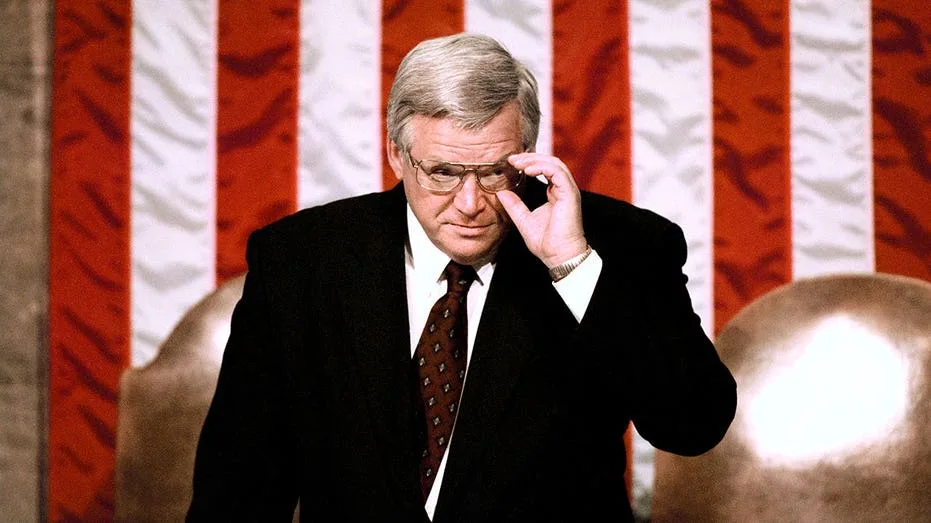
Former House Speaker Dennis Hastert, a Republican from Illinois, whose ascent to the top leadership position was largely unforeseen, passed away over the weekend at the age of 84 due to natural causes. Years after he departed Capitol Hill, a deeply disturbing secret about Hastert's past came to light, irrevocably altering his public image.
Nearly two decades ago, in the fall of 2006, House Republicans faced the imminent threat of losing their majority in the upcoming midterm elections. Speaker Hastert was grappling with a burgeoning crisis. News had just emerged that then-Representative Mark Foley, a Republican from Florida, had sent inappropriate messages to high school-aged male teens serving as House pages. On September 29, 2006, the Republican-led House convened, attempting to finalize legislative business before members returned home to campaign. However, circumstances were not favorable for the GOP; public sentiment was turning against President George W. Bush and the ongoing war in Iraq, and Democrats were poised to reclaim the House in November.
During this tumultuous period, reporters observed Hastert moving through Statuary Hall toward the Speaker’s office. A journalist questioned Hastert about Foley, asking, “Did he call you?” Another journalist pressed him on the issue, inquiring, “What are you going to do about it?” Hastert responded indistinctly, muttering, “We’ll talk about that shortly,” his glasses nearly slipping as he hurried into his suite.
Approximately an hour later, Hastert, along with outgoing Senate Majority Leader Bill Frist, a Republican from Tennessee, and other senior Republicans, held a brief press conference. The event was intended to highlight a national security bill they had just passed, serving as a legislative sendoff before lawmakers began campaigning. Senator Frist specified that questions would only be taken regarding the legislation, repeating, “Only on the bill.” Silence followed.
A journalist then posed a question, stating there were inquiries on other topics, specifically regarding Foley. Frist acknowledged this, pushing back from the table. The Tennessee Republican understood the nature of the impending questions and was content that addressing the Foley scandal would fall to Hastert, particularly as Frist harbored presidential ambitions for 2008.
When asked about Foley, Hastert offered an inaudible or vague response, which was barely suitable for broadcast. He mumbled something to the effect that he was “not very happy” about the situation. Nevertheless, it provided a soundbite from the Speaker of the House on the scandal, just as a beleaguered Republican party concluded the event to commence midterm campaigning. The press conference was swiftly adjourned thereafter.
Days later, local reporters in Illinois pressed Hastert on his management of the Foley matter. In Washington, a question was posed to one of the Speaker’s aides: why had Hastert, given his background as a former teacher and coach, not been more assertive in protecting the teen pages? The unsettling answer to that question would emerge years later.
A Troubled Legacy Unveiled
Dennis Hastert, who died at 84, is remembered as one of the most infamous figures in American politics. He served as the longest-reigning Republican Speaker in history, wielding the gavel from 1999 to 2007. Hastert's rise to the Speakership was largely unexpected, occurring due to the missteps of others. Despite his extensive tenure in Congress, the revelations about Hastert nearly a decade after he left office exposed him as one of the most deeply disturbing individuals to have served in that body. In fact, Hastert holds the unenviable distinction of being the highest-ranking U.S. official ever to serve jail time.
Unbeknownst to virtually everyone at the time, Hastert was an unrestrained sexual predator. Referred to as “Coach” rather than his official title of “Mr. Speaker” by many Capitol colleagues, Hastert engaged in predatory behavior targeting adolescent males when he taught high school in the 1960s and 1970s.
Hastert himself was never implicated in the House page scandal, a program that was subsequently discontinued, despite its long history. However, in retrospect, Hastert's handling of the events surrounding the House pages gained a disturbing new context years later.
Democrats secured a decisive victory in the 2006 midterms. Hastert chose not to seek a leadership position in the new Congress, and likely would not have won. He remained a rank-and-file member for a few months before resigning from the House in late 2007.
After his departure from Congress, Hastert largely faded from public view, a reflection of his characteristic reticence. As Speaker, he avoided media interviews and was rarely seen in the Capitol corridors. He famously defended his reluctance to engage with the press corps by claiming he was primarily a “listener.”
The Unveiling of a Dark Past
Hastert’s otherwise unremarkable tenure as Speaker took a sinister turn in 2015. Federal banking regulators flagged unusual, large cash withdrawals from his accounts. These transactions suggested potential blackmail, prompting an investigation. It was through this inquiry that the truth emerged: Hastert was making payments to conceal past sexual abuses involving minors.
Federal authorities indicted Hastert on charges of lying to investigators and evading banking laws. He subsequently pleaded guilty to the bank crimes, while the charge of making false statements was dropped by prosecutors. Federal Judge Thomas Durkin unequivocally declared the former Speaker to be “a serial child molester.” In court, Hastert admitted to “mistreating athletes” and “taking advantage” of those he was supposed to mentor.
Prosecutors never brought sex crime charges against Hastert. He ultimately served 13 months of a 15-month sentence at a federal facility in Rochester, Minnesota.
It is noteworthy how long such a grave secret remained hidden from public view for an individual holding such a high office in American government.
An Unexpected Rise to Power
The events of nearly 20 years ago, when the Foley scandal erupted and Republicans faced the end of Hastert's Speakership, are instructive. However, the day that propelled him into leadership is even more illuminating.
Republicans narrowly avoided losing the House in the 1998 midterms. House Speaker Newt Gingrich, a Republican from Georgia, had become politically vulnerable, and Republicans opted for his departure. In late 1998, they selected then-Representative Bob Livingston, a Republican from Louisiana and chairman of the Appropriations Committee, to become Speaker in 1999. But then came December 19, 1998—the Saturday before Christmas.
That Saturday before Christmas, the House convened to approve articles of impeachment against President Clinton in connection with the Monica Lewinsky scandal. This marked only the second time in American history that the House impeached a sitting President. On the same day, President Clinton also ordered airstrikes against Iraq for violating no-fly zones established after the first Gulf War, creating another major news story. Yet, the night before, news broke that Livingston, the Republican Speaker-designee, had engaged in an affair with a lobbyist.
This revelation stood in stark contrast to the House's efforts to impeach President Clinton for his own sexual conduct.
On the morning of December 19, 1998, Livingston took to the House floor, demanding that the President resign for his transgressions. “No! You resign! You resign!” came a unified chorus of shouts and jeers from Democratic members in the House chamber. Livingston paused, raising his hand to quiet the din. The Louisiana Republican then announced he would not stand as the GOP’s nominee for Speaker when the new Congress convened in January 1999, promising to resign from the House a few months later.
Chaos erupted within the Capitol. House Republicans scrambled to find a new Speaker-designee. By nightfall, they persuaded J. Dennis Hastert, the Chief Deputy Whip in the Republican Conference, to take on the role. While part of the GOP leadership team, Hastert was a relatively obscure member whose role primarily involved vote counting on the floor.
Many reporters covering Congress at the time were unfamiliar with Hastert, and he received minimal scrutiny from the press. The focus of the news cycle was dominated by other major events: the airstrikes against Iraq, the Livingston scandal, and the historic impeachment proceedings against a U.S. President.
Hastert assumed the Speaker’s gavel in January 1999 and held the position for eight years, a longer tenure than any other Republican Speaker. His reprehensible past remained hidden. Ultimately, however, Dennis Hastert did not take to the grave the abhorrent secrets he had concealed for so long.