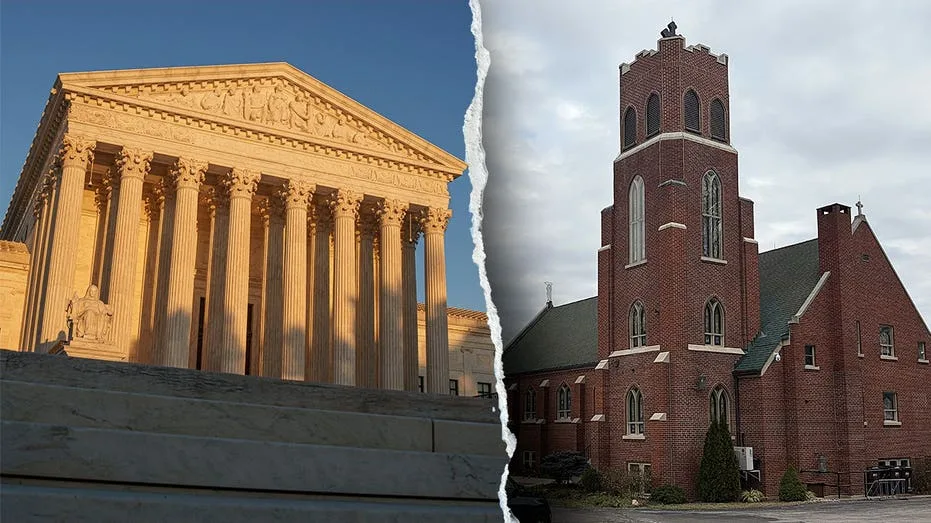
On Thursday, the Supreme Court of the United States announced it would take up a case involving a Kentucky church's endeavor to construct a prayer grotto on its property. The dispute centers on the interpretation of "substantial burden" concerning religious exercise, as defined by federal land-use legislation.
The Kentucky Grotto Dispute
The focal point of the legal challenge is a proposed grotto, envisioned to be 16 by 39 feet, which court documents indicate would feature a shrine dedicated to the Virgin Mary, a surrounding plaza, a walking path, and a retaining wall. An attorney involved in the case, Gardner, likened its approximate 600-square-foot area to the size of a standard swimming pool.
The church submitted an application in March 2021 for a conditional-use permit and a variance to construct this grotto behind its main building. The project is intended to honor the Virgin Mary's apparition to Saint Bernadette in Lourdes, France. Notably, the church structure itself has been present on the site for nearly a century, predating the Park Hills zoning ordinance established in 1974.
The property's history is somewhat intricate, extending beyond a simple description of the case. The planned grotto encompasses an adjacent parcel initially subject to a perpetual lease, which would be transferred to the religious organization upon the project's approval. However, unlike many disputes involving religious land use, Gardner noted that the church's initial conflict in this instance was not with the local government.
The Park Hills Board of Adjustment granted approval for the church’s permit in April 2021. Nevertheless, two neighboring property owners, Joel and Elizabeth Frederic, voiced objections and subsequently challenged the board’s decision in Kentucky state court.
A trial court initially ruled in favor of the church. However, the Kentucky Court of Appeals reversed this judgment, concluding that the board had exceeded its authority in approving the construction and found no violation of federal religious land-use law. The Kentucky Supreme Court affirmed that RLUIPA ruling in December 2025, prompting the church to seek review from the nation's highest court.
Interpreting Federal Religious Land-Use Law
Central to the case is the Religious Land Use and Institutionalized Persons Act (RLUIPA), a federal statute enacted in 2000. This law was designed to safeguard religious institutions from specific impediments to the use of their property.
The church petitioned the Supreme Court to consider two questions under RLUIPA, but the Court agreed to hear only one: whether prohibiting a religious institution from constructing a religious structure on its own property constitutes a "substantial burden" on religious exercise as defined by the law.
Gardner explained that since RLUIPA’s enactment, lower courts have developed divergent interpretations of the law, resulting in varying levels of protection for religious organizations depending on the jurisdiction where a dispute arises. He contends that the Supreme Court now has a crucial opportunity to establish a uniform national standard.
In their petition to the Supreme Court, the Missionaries of St. John the Baptist similarly argued that federal and state courts are divided on how to determine if a land-use restriction creates a "substantial burden" under RLUIPA. Conversely, the Frederics, in their opposition brief, disputed this characterization. They asserted that appellate courts generally consider analogous factors, and differing outcomes typically reflect variations in factual circumstances. The Frederics also maintained that the Missionaries failed to demonstrate that alternative locations for the grotto were unavailable.
Broader Implications for Zoning and Religious Freedom
This case brings two significant constitutional areas of law into direct confluence: the right to religious exercise and the authority of local governments to regulate property usage.
While Gardner acknowledged the legitimate role zoning plays in local government organization, he emphasized that these regulations must still adhere to federal protections for religious exercise. This fundamental question, he indicated, extends far beyond the specific instance of a single prayer grotto in Kentucky.
The Supreme Court's impending decision could have far-reaching effects on disputes involving churches, synagogues, ministries, and other religious organizations seeking to utilize their properties for worship or other religious activities, according to Gardner. He cautioned that an overly restrictive interpretation of the federal law could lead to "dire consequences" for religious land use across the United States.
For the Missionaries of St. John the Baptist, however, this case — which now holds the potential to reshape religious land-use law nationwide — began with a much humbler aspiration: a roughly 600-square-foot space dedicated to prayer.